

Understanding The Beckham Law
Spain’s Special Expatriate Tax Regime, known as the “Beckham Law”, allows qualifying individuals to be taxed as non-residents for six years. The regime provides a favourable framework for attracting highly skilled professionals to Spain, limiting taxation to Spanish-source income, gains and assets. Recent inspections indicate the Spanish Tax Agency is increasing scrutiny, making correct application essential.
Key Features of the Regime
Eligibility and Scope
The regime is governed by Article 93 of the Spanish Personal Income Tax Law. It allows individuals who become tax resident in Spain to be taxed as if they were non-resident. To qualify, applicants must:
- Not have been Spanish tax resident in the five previous tax years
- Relocate to Spain for one of the following reasons:
- An employment contract (except professional athletes)
- Appointment as a director of a company (subject to shareholding limits)
- Performance of entrepreneurial activity
- Provision of services by highly qualified professionals to start-ups or R&D-focused entities
- Not obtain income through a permanent establishment in Spain
- Apply within six months from starting the qualifying activity by submitting Form 149with the required documentation.
Failure to meet these conditions prevents access to the regime or may lead to later regularisation.
Tax Benefits Available
The regime applies for six full tax years: the year of tax-residence acquisition plus five additional years. Key features include:
- Only Spanish-source income and gains are taxable
- Employment and entrepreneurial income are always treated as Spanish-source and therefore taxed in Spain, even if work is performed abroad
- Wealth Tax and Solidarity Tax apply only to Spanish-located assets
- Worldwide inheritances and gifts are taxable under Spain’s Inheritance and Gift Tax
- No requirement to file Form 720 (foreign asset reporting)
Tax Rates
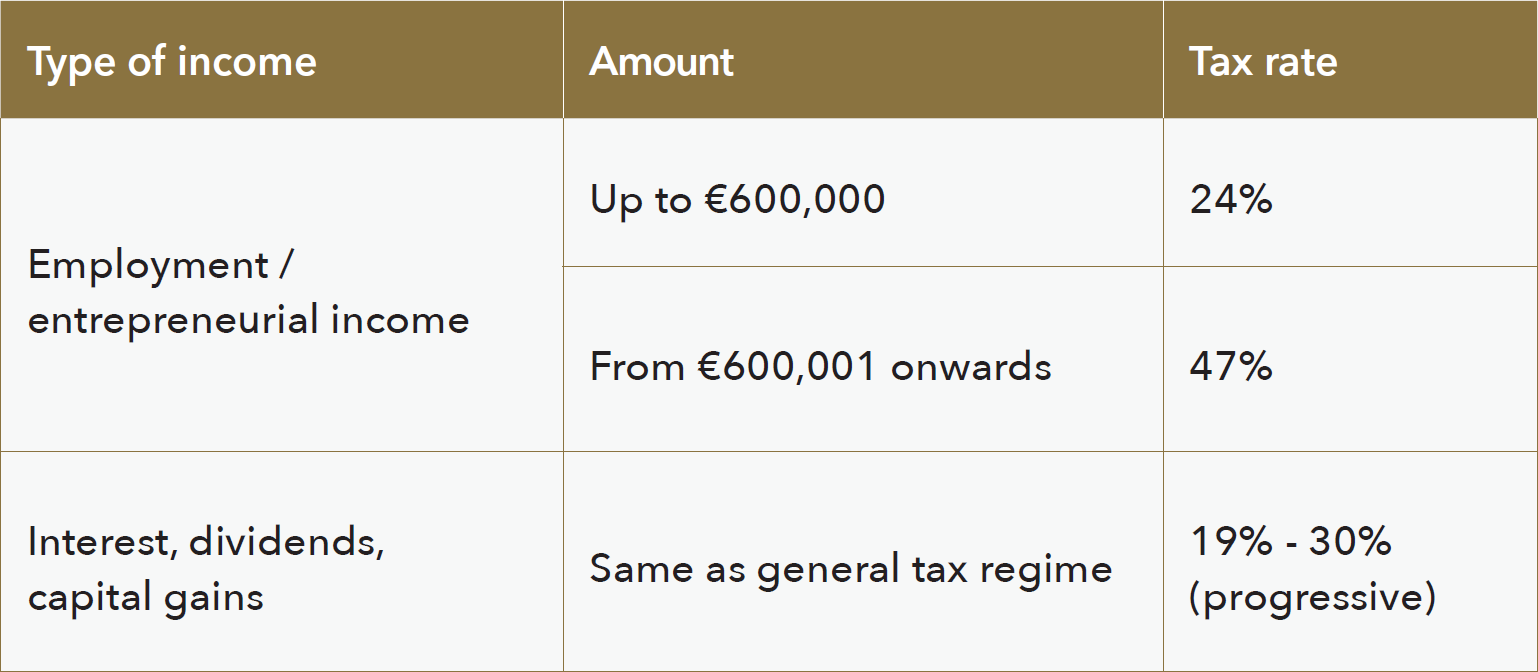
Family members (e.g. spouse, children under 25, or any age if disabled) may join the regime if they relocate with the taxpayer, meet some qualifying conditions and have lower taxable income.
Clients for Whom the Regime Is Suitable
The Beckham Law is designed for:
- Highly skilled professionals relocating to Spain for employment
- Directors of companies (subject to shareholding limits)
- Entrepreneurs or individuals working in innovation, R&D or start-up ecosystems
- Professionals with significant foreign-source investment income and gains
- Clients intending a medium-term stay (six years)
It is especially beneficial for clients whose non-Spanish income and gains are substantial, as most foreign-source income remains outside the Spanish tax net.
Clients for Whom the Regime Is Not Suitable
The regime is less appropriate for:
- Individuals who have been Spanish tax resident in the previous five years
- Clients whose income arises through a permanent establishment in Spain
- Individuals whose professional activity does not meet the strict qualifying criteria
- Professional athletes (who are specifically excluded)
- Individuals unable to provide evidence of genuine relocation or economic activity in Spain
Considerations for Advisers
When advising clients on the Beckham regime, advisers should consider:
- Whether the client can demonstrate genuine relocation, not merely formal residence
- The importance of maintaining eligibility each year of the six-year period
- That employment/entrepreneurial income is always treated as Spanish-source and taxable in Spain, even when some duties are performed abroad
- Future implications for Wealth Tax and Inheritance and Gift Tax, particularly for globally mobile families
- The shareholding limits for directors and restrictions on related-party appointments
- Administrative requirements, including timely submission of Form 149
- Professional and bespoke tax advice is highly recommended to make sure the Beckham Law can be applied for and is beneficial for the client
Recent increases in inspections show the Spanish Tax Agency is closely examining artificial arrangements, mis-structured employment activities and incomplete documentation. Advisers should ensure clients maintain strong evidentiary support for their relocation and activities.