

Context and What Changed
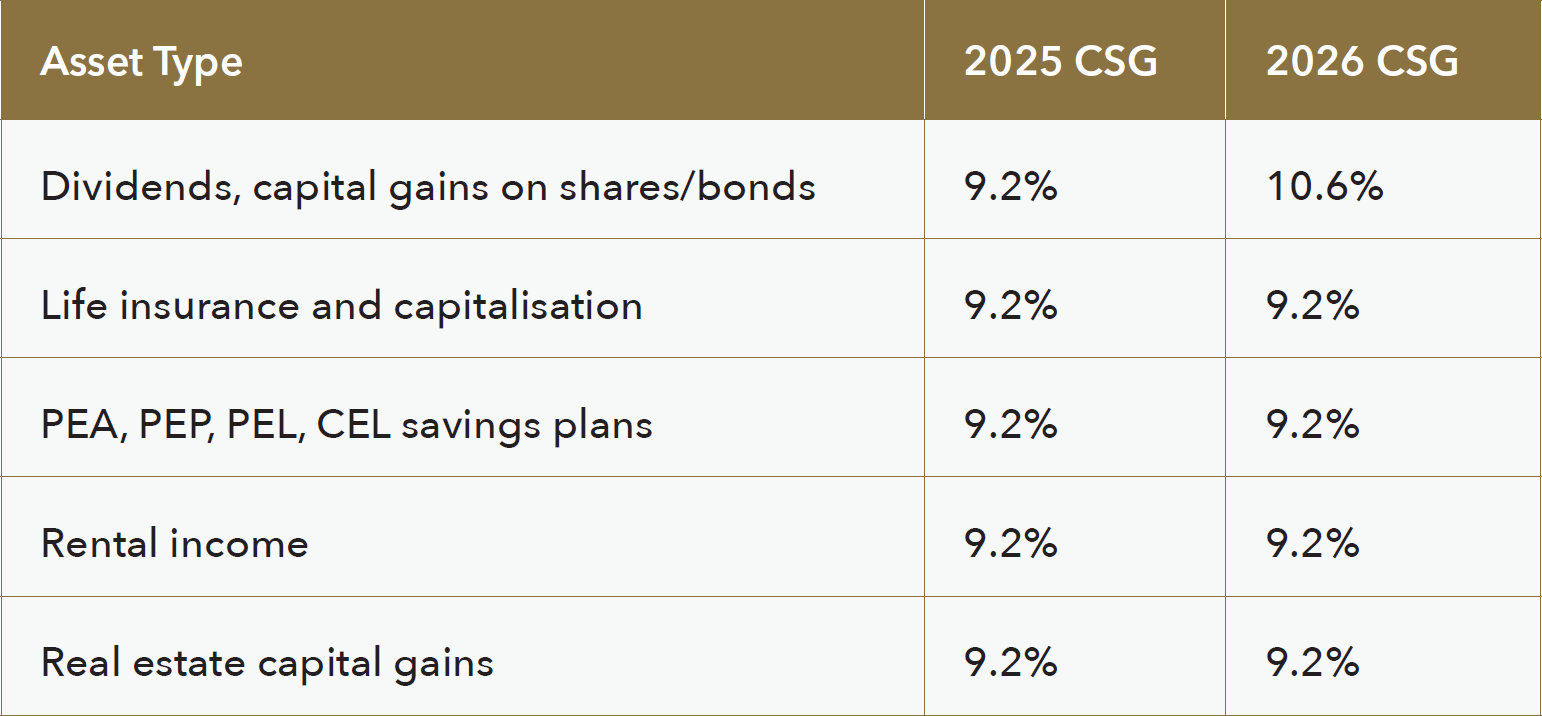
Political constraints prevented Parliament from finalising the Finance Law by year-end, but the law on financing social contributions for 2026 was passed. A government-led compromise distinguishes “financial income” from “popular savings”.
- CSG increase to 10.6% applies only to pure financial income (e.g., dividends, capital gains on shares and bonds).
- Popular savings keep the 9.2% CSG: life insurance and capitalisation contracts, PEA (Plan d’Épargne en Actions), PEP, PEL/CEL.
- Other common incomes (e.g., rental income, real estate capital gains) continue at 9.2% CSG.
Because the Contribution pour le Remboursement de la Dette Sociale (CRDS) (0.5%) and solidarity levy (7.5%) are unchanged, overall social levies now diverge:
- Pure financial income:
10.6 + 0.5 + 7.5 = 18.6% - Popular savings (including life insurance/capitalisation contracts):
9.2 + 0.5 + 7.5 = 17.2%
Comparative Table of Rates (CSG component)
Overall Social Levies
- Insurance/capitalisation: 17.2%
- Pure financial income: 18.6%
Expatriates in France: Who Is (and Isn’t) Affected?
Expatriates affiliated to a foreign social security system and holding a valid S1 form are generally exempt from CSG and CRDS on investment income. As a result, the increase to 10.6% CSG does not affect them. However, expatriates remain subject to the 7.5% solidarity levy on applicable income.
Following the UK’s withdrawal from the EU (agreements of 12 November 2019 and 30 December 2020), UK expatriates can continue to benefit from the CSG/CRDS exemption from 1 January 2021, provided they are:
- Affiliated to the UK social security system.
- Nationals or legal residents of France, the UK, or another EU Member State.
- Not covered by a compulsory French social security scheme.
Bottom line: The CSG hike principally impacts domestic investors and expatriates without S1 coverage.
Why It Matters for Wealth Professionals
The shift widens the differential between direct portfolios and “popular savings”. For clients comparing portfolio investing with insurance or capitalisation contracts, this change reinforces the relative attractiveness of long-term, policy-based solutions:
- Lower overall social levies (17.2% vs. 18.6%) on withdrawals from insurance/capitalisation.
- Continued benefits around tax deferral, timing and management of taxable events, and estate planning (including favourable rules on death for insurance contracts).
- For expatriates with S1 coverage, the CSG/CRDS component is removed, leaving only the 7.5% solidarity levy – further strengthening the comparative case.