
#3 Spring 2025

Strategic Gifting for French Expatriates: Maximising Tax Efficiency Before Returning to France

Benjamin Fiorino Wealth Planner / Tax and Legal Counsel, France and Monaco View profile

For internationally mobile UHNW families, wealth transfer planning is essential to minimise tax liabilities. The French tax system imposes different rules depending on the taxpayer’s residency status, making the timing of a gift a critical element in optimising tax efficiency.

Understanding French Gift Tax Rules

To determine the applicable taxation for a gift in an international context, there is no difference as to whether the gift deed is executed in France or not.

France has few conventions on gift taxes with other countries (e.g., Germany, Austria, United States, Guinea, Italy, New Caledonia, Saint Pierre and Miquelon, Sweden). If a tax convention exists, the rules outlined in the convention will apply to determine in which country gift taxes may be due.


In the absence of a tax convention, French domestic law sets out the following principles:
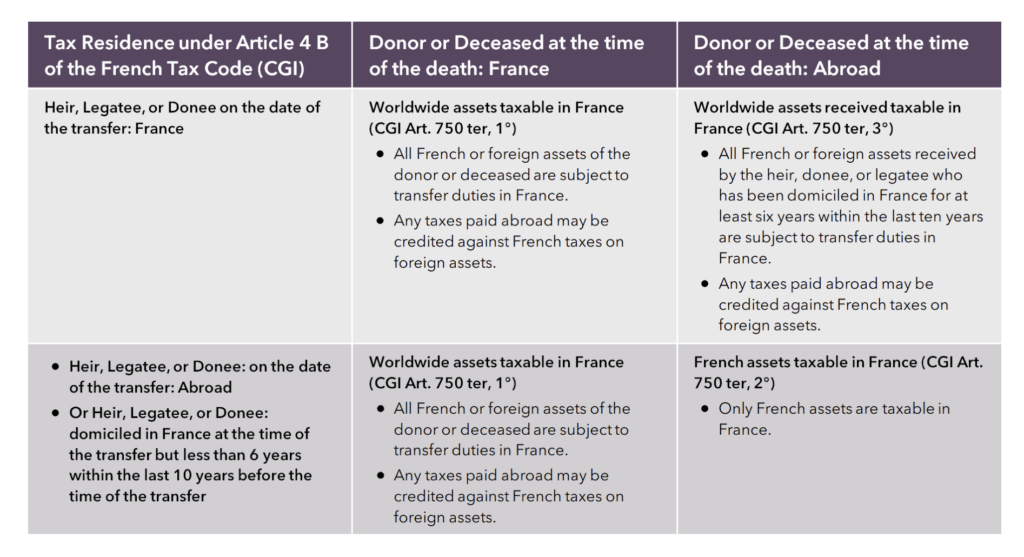
To avoid the risk of double taxation in France and another state in the absence of a tax treaty, French domestic law provides for a foreign tax credit. The gift taxes paid abroad are then credited against the gift taxes due in France for movable and immovable property located outside of France.


Case Study Insights

To understand how this solution works, read the case study titled ‘A French Expatriate Family in Dubai’ in the Case Study Insights section below. This study highlights two potential solutions:
(1) gifting while residing in Dubai and (2) gifting after repatriation. It also demonstrates the substantial tax savings and benefits of using life insurance policies for wealth transfer.

Visit the Case Study Insights section below, or click here.

Precautions and Compliance Measures

  • Declaration Requirement: The gift must be declared to French tax authorities before returning. For manual gifts made abroad, the chargeable event for taxation occurs when the gift is revealed. Thus, in the case of a manual donation made abroad which is subsequently revealed by the beneficiary, who has become a resident of France, the manual donation falls within the scope of French tax under the provisions of paragraph 3 of Article 750(3) of the French Tax Code. This applies regardless of the date on which the property or sum subject to the manual donation is transferred to the beneficiary (Réponse ministérielle Richard 07/11/2024).
  • Risk of Succession Reassessment: Undeclared manual gifts could later be subject to French inheritance tax upon the donor’s death.
  • Reinvestment into Life Insurance: The children can use the gifted assets to subscribe to a life insurance policy, securing long-term tax benefits in France just before repatriation. Under French law, minors are authorised to take out life insurance policies (under the legal administration of their parents).

Conclusion

Strategic gifting prior to repatriation to France offers significant tax advantages, enabling expatriates to mitigate potential future liabilities. However, strict adherence to French tax regulations is crucial to avoid unintended tax consequences.

Advisers must guide clients through the intricacies of optimal wealth transfer strategies, ensuring compliance with reporting obligations while also helping to structure life insurance policies as effective vehicles for these donations.

This approach not only maximises tax efficiency but also provides long-term benefits by deferring tax once the family returns to France